Leatherette vs Corrugated Board Jewelry Boxes: Which Is Better?
Leatherette and corrugated board are both popular for jewelry boxes, but they make very different impressions. We compare cost, durability, look and sustainability so you can pick the right one.
Whether you order 100 boxes or 10,000, the same principles apply. Start with fit and protection, then layer in branding.
Start with the piece, not the box
Measure handmade jewelry in the position you want it displayed. Add room for the insert, typically 3–6 mm on each side, and note the depth needed for stones or clasps. A box that's sized from the jewelry outward always looks more intentional than one picked from a stock size chart.
If you sell several sizes, consider a single outer box with interchangeable inserts. It keeps your branding consistent and simplifies reordering.
Box styles that work for handmade jewelry
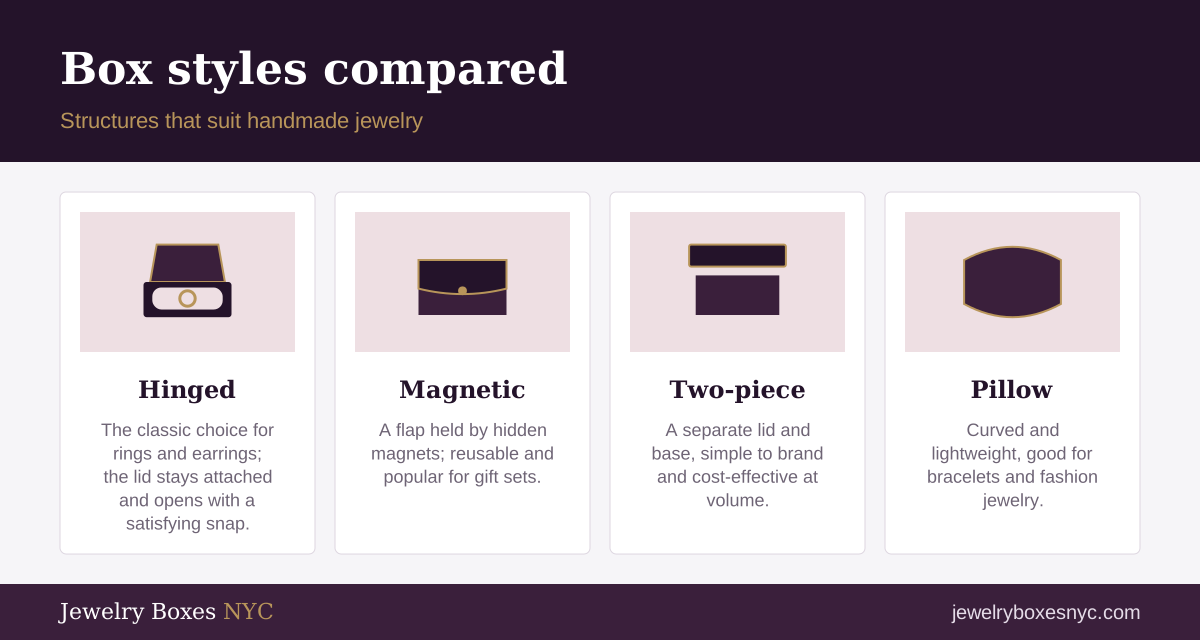
Most jewelry packaging falls into a handful of structures. For handmade jewelry, these are worth considering:
- Hinged boxes: the classic choice for rings and earrings; the lid stays attached and opens with a satisfying snap.
- Magnetic closure boxes: a flap held by hidden magnets; reusable and popular for gift sets.
- Two-piece boxes: a separate lid and base, simple to brand and cost-effective at volume.
- Pillow boxes: curved and lightweight, good for bracelets and fashion jewelry.
How leatherette compares
| Factor | Leatherette | Corrugated board |
|---|---|---|
| Unit cost | Moderate–High | Low |
| Perceived luxury | High | Low–Moderate |
| Crush resistance | Moderate | High |
| Print quality | Foil or deboss | Good |
| Recyclability | Low | High |
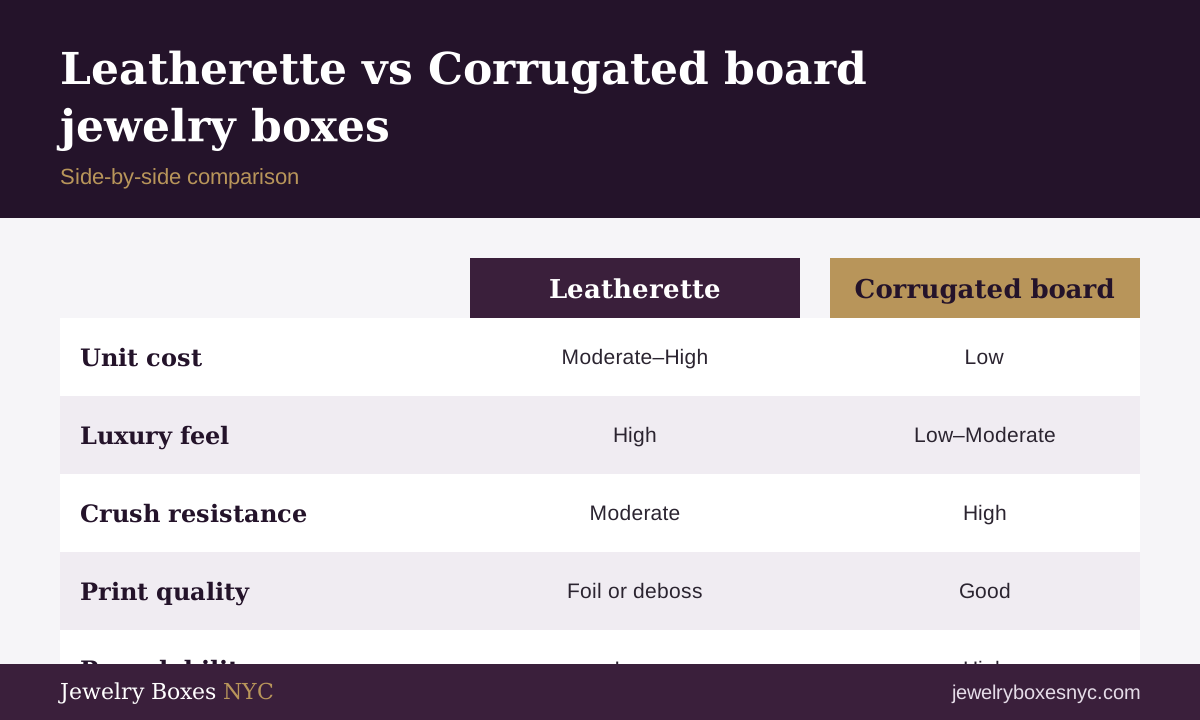
Ratings vary with board thickness and finish, so treat this as a starting point and ask for samples before committing to a large run.
Choosing materials
Leatherette is a strong option when it suits your brand, but it's not the only one. Rigid chipboard wrapped in printed paper feels premium and protects well. Kraft reads as natural and eco-minded. Velvet and suede are timeless for fine jewelry. Corrugated board is the practical pick for e-commerce shipping.
Match the material to the price point: customers notice when a $300 piece comes in a flimsy box, and they also notice when packaging feels excessive for a $20 piece.
Branding with magnetic closures
Magnetic closures is one of the simplest ways to add character. Use it on one element, such as the logo or a border, so it draws the eye without overwhelming the box.
Other effective touches include a printed inside lid, a branded insert card with care instructions, a ribbon in your brand color, and a matching outer sleeve for shipping.
Protecting jewelry in transit
Inserts do most of the protective work. Slotted foam holds rings upright, velvet pads keep handmade jewelry from sliding, and cotton fill cushions mixed items. For shipping, place the presentation box inside a fitted mailer so it arrives without dents.
A small anti-tarnish strip inside the box helps silver pieces arrive bright, especially in humid months.
Designing the unboxing moment
The best unboxing experiences feel calm. A box that opens smoothly, an insert that presents handmade jewelry at the right angle, and a short printed note are often enough.
Small details carry a lot of weight: tissue paper in a brand color, a sticker seal on the mailer, a care card that explains how to clean the piece. Customers photograph these moments and share them, which turns packaging into free marketing.
If you sell online, film your own unboxing before launch. It quickly reveals anything that feels awkward or cheap.
What affects the price of custom jewelry boxes
Unit price depends on a handful of factors, and knowing them helps you get more from your budget:
- Quantity: setup costs are spread across the run, so price per box falls as quantity rises.
- Structure: rigid and magnetic boxes involve more handwork than folding cartons.
- Size: larger boxes use more board and wrap paper.
- Printing: full color inside and out costs more than a one-color logo.
- Finishes and inserts: foil, embossing, velvet and foam each add a step.
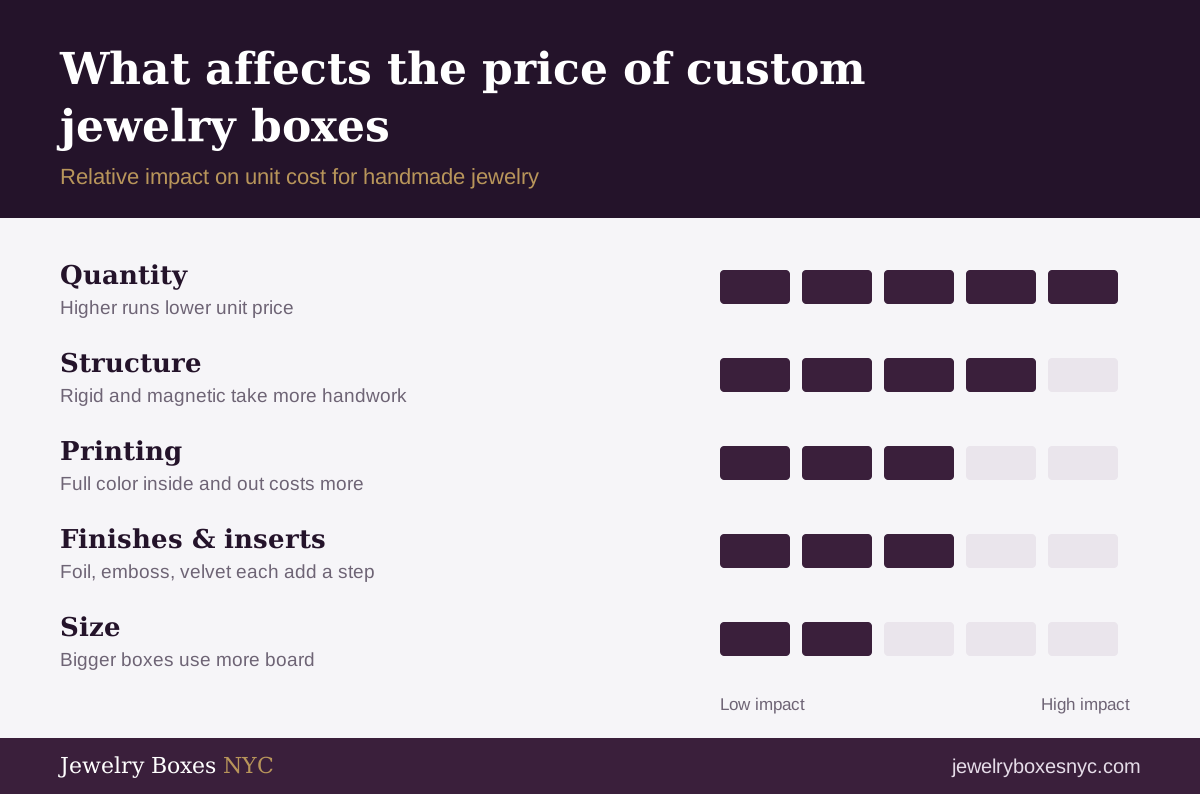
A practical approach for online jewelry stores is to invest in one hero finish and keep everything else simple. That gives you the premium feel where it counts without inflating the cost of every box.
Sustainability considerations
Reusable boxes are inherently more sustainable. A sturdy box that customers keep for storing jewelry stays out of the waste stream and keeps your brand in view.
If you choose eco-friendly materials, print a short note on the box explaining how to recycle it. Customers appreciate the clarity, and it reinforces your brand's values.
Working with a packaging partner
A good packaging supplier will ask about your jewelry before quoting. Expect questions about dimensions, weight, how the box will be sold or shipped, and your deadline. At Jewelry Boxes NYC, every quote includes a recommended structure and insert, and every order includes a free digital proof.
Before approving a proof, check spelling, logo placement, colors and dimensions carefully. Changes are easy at the proof stage and expensive after production starts.
Common mistakes to avoid
- Ordering a stock size that leaves the piece loose.
- Choosing a finish that scuffs easily on a box that ships.
- Skipping the proof stage on a large order.
- Leaving no room in the budget for shipping mailers.
- Printing small text that becomes unreadable at final size.
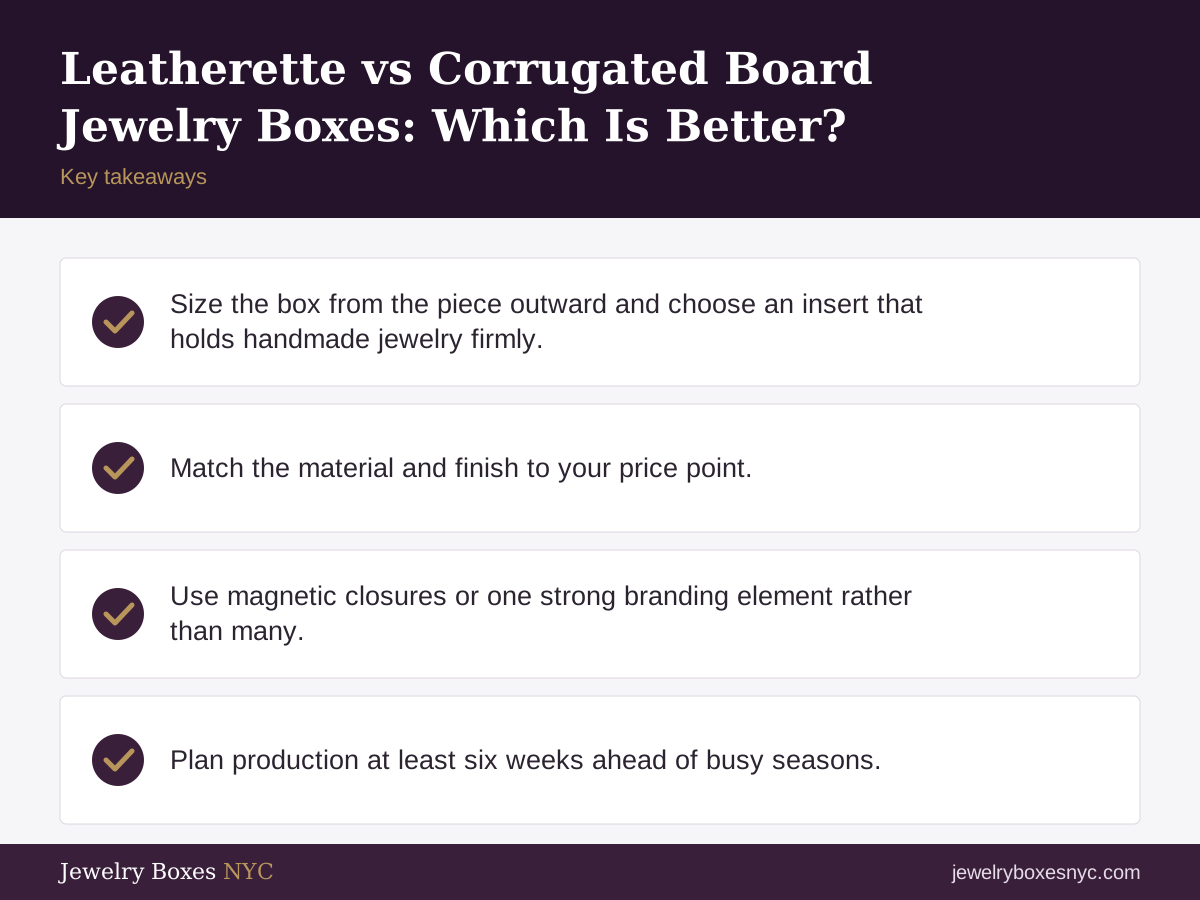
Key takeaways
- Size the box from the handmade jewelry outward and choose an insert that holds it firmly.
- Match material and finish to your price point.
- Use magnetic closures or one strong branding element rather than many.
- Plan production at least six weeks ahead of busy seasons.
Frequently asked questions
What size box do I need for handmade jewelry?
Measure the piece as it will be displayed and add 3–6 mm per side for the insert. We can recommend a size if you send your measurements with your quote request.
What is the minimum order for custom jewelry boxes?
Jewelry Boxes NYC produces custom jewelry boxes from 100 units.
How long does custom packaging take?
Most orders ship 8 to 12 business days after proof approval.
Need custom jewelry boxes?
Tell us what you're packaging and we'll send pricing within one business day.
Get a free quote